
How to Choose Lawn Irrigation Supplies in Bend
A lawn can look green in May and still struggle by July if its irrigation system was chosen for a wetter climate. In Bend and across Central Oregon, dry air, sandy soils, wind, and summer water demands expose weak designs quickly. Knowing how to choose lawn irrigation supplies starts with your property’s water source, soil, turf area, and planting layout – not with whichever sprinkler head is on sale.
The goal is not simply to put water on the lawn. It is to apply the right amount evenly, at a rate the soil can absorb, with as little waste as possible. A well-chosen system helps protect your water budget, supports deeper roots, and gives your lawn a better chance through High Desert heat.
Start With Your Site, Not a Shopping List
Before selecting pipe, valves, sprinkler heads, or a controller, take a close look at the areas you need to water. A compact lawn surrounded by planting beds needs a different system than a large open turf area, and a newly renovated lawn has different needs than established turf with mature trees.
Measure each lawn and landscape area separately. Note slopes, sunny exposures, shade from trees or buildings, and places where water naturally runs off. Central Oregon’s sandy or rocky soils often accept water quickly at first, but uneven grading and compacted areas can still create dry spots or runoff. Wind also matters. An exposed lawn may need lower-angle, more efficient sprinkler coverage than a protected backyard.
It is also worth checking your available water flow and pressure before buying supplies. Flow is usually measured in gallons per minute, while pressure is measured in pounds per square inch. These two numbers determine how many sprinkler heads can operate on a single zone. If too many heads run at once, coverage becomes weak and uneven. If the pressure is too high, sprinklers can create fine mist that blows away before it reaches the root zone.
A simple flow test can provide a useful starting point, but difficult sites, large landscapes, or low-pressure systems benefit from professional guidance. The right design on paper prevents expensive changes after trenches are filled.
Choose Irrigation by Plant Type and Water Need
One of the most common irrigation mistakes is putting every part of a landscape on the same schedule. Turf, shrubs, perennials, vegetable gardens, and native or drought-tolerant plants do not use water at the same rate. Separating them into appropriate zones gives you much more control.
Use Sprinklers for Lawn Areas
For most turf, pop-up spray heads or rotor-style sprinklers are the practical choice. Spray heads apply water more quickly and work well in smaller lawn areas. Rotors cover a larger radius and generally apply water more slowly, which can be useful on broad lawns or gently sloped sites.
The key is matched precipitation. Every head within a zone should deliver water at a compatible rate. Mixing spray heads and rotors in the same zone is rarely a good idea because they run for different lengths of time. One portion of the lawn will be overwatered while another stays thirsty.
Look for heads with efficient nozzles, reliable adjustment, and appropriate spacing for the area. In windy Central Oregon locations, do not stretch spacing to the maximum advertised distance. Overlapping coverage is what keeps the lawn from developing dry rings, brown edges, and isolated green patches.
Use Drip Irrigation for Beds and Trees
Drip irrigation is usually the better choice for shrubs, flower beds, vegetable gardens, and young trees. It delivers water near the roots instead of spraying it into dry air or onto mulch. That can reduce evaporation, discourage weeds between plants, and make it easier to tailor watering to the needs of each planting area.
Drip supplies should be selected as a complete system. Tubing, emitters, fittings, filters, pressure regulators, and flush points all have a role. A filter is especially valuable because debris can clog small emitters. A pressure regulator protects drip tubing and helps each emitter perform more consistently.
For trees, avoid placing all water directly against the trunk. As trees establish, expand the watering area outward to encourage roots to spread. This creates a more stable, drought-tolerant tree over time.
Select the Core Supplies That Make the System Work
A dependable irrigation system is made of more than sprinkler heads and pipe. Choosing compatible components protects performance and makes future repairs easier.
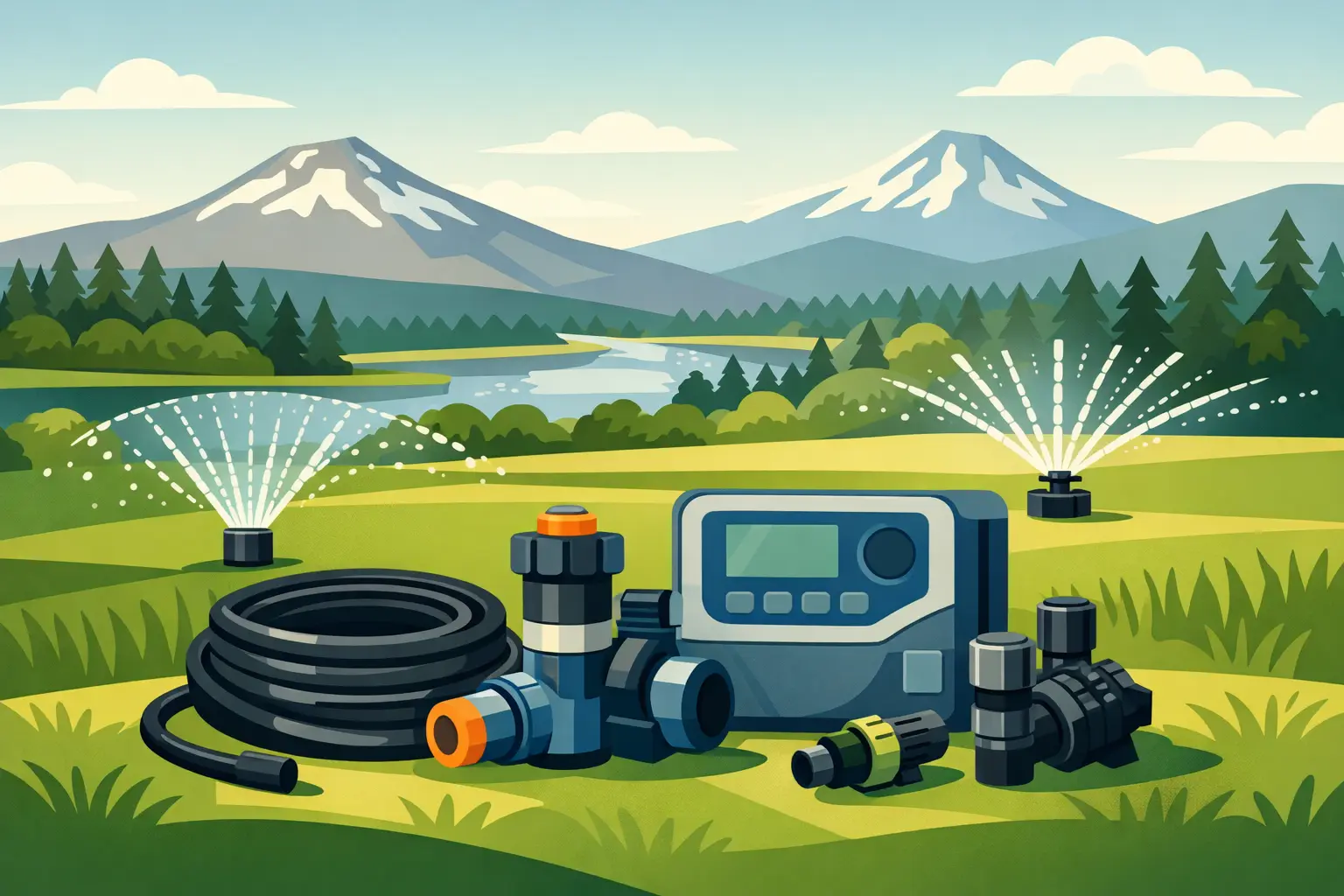
For a typical residential system, the essential supply categories include:
- Polyethylene or PVC pipe sized for the system’s flow and pressure requirements
- Control valves that allow each irrigation zone to run independently
- A controller or smart timer that schedules watering by zone
- Backflow protection required to help protect the domestic water supply
- Pressure regulation and filtration, especially for drip irrigation
- Fittings, risers, swing joints, wire, valve boxes, and repair parts suited to the chosen pipe system
Pipe choice depends on the application and local installation practices. Poly pipe is flexible and useful for many irrigation layouts, while PVC offers rigid, durable connections. Neither is automatically right for every project. What matters is using a pipe type and pressure rating appropriate for the water source, burial depth, and fittings you plan to use.
Do not treat fittings as an afterthought. Poor-quality or mismatched fittings are a common source of leaks, particularly after winter freeze-thaw cycles. Keep a few compatible repair fittings on hand once your system is installed. A small repair becomes much easier when you know exactly what pipe and connection type are in the ground.
Plan for Central Oregon’s Freeze Risk
Irrigation systems in Central Oregon need to be designed and maintained with winterization in mind. A system that performs well in August can suffer cracked pipes, damaged valves, and broken backflow components if water remains in the lines through freezing temperatures.
Choose a layout that allows for proper seasonal blowout and access to key components. Valves should be located in accessible boxes, and backflow assemblies should be installed where they can be serviced and protected according to local requirements. If you are planning a new system, ask about supply choices that simplify fall shutdown and spring startup.
This is also a reason not to bury every connection without a plan. Accessible valve boxes and thoughtful placement save time when a repair is needed. For larger properties and commercial landscapes, clear zone labeling is worth the effort. It helps homeowners, maintenance teams, and irrigation technicians identify problems without guesswork.
Use a Controller That Supports Water-Wise Habits
A basic timer can work well if you adjust it regularly. However, a programmable controller with multiple start times, seasonal adjustment, and separate zone schedules gives you much better control. Smart controllers can be a strong option for homeowners and landscapers who want weather-responsive scheduling, provided the system itself is designed correctly.
No controller can compensate for poor coverage, broken heads, or a zone that combines plants with very different water needs. Think of the controller as the decision-maker for a system that has already been built thoughtfully.
For lawns, deeper and less frequent watering is generally more beneficial than shallow daily watering once turf is established. The exact schedule depends on soil, weather, grass type, and local watering restrictions. Sandy soils may require shorter cycles with more frequent starts to prevent water from moving beyond the root zone too quickly. This cycle-and-soak approach can also help on slopes or compacted areas where runoff is a concern.
Avoid Overbuying and Under-Designing
It is tempting to buy a prepackaged irrigation kit or choose supplies based only on price. Kits can be useful for simple applications, but they may not include the pressure regulation, filtration, nozzle selection, or zone capacity your property requires. The lowest-cost sprinkler head can also become expensive if it wastes water or needs frequent replacement.
On the other hand, not every lawn needs a complex system with premium features. A small, level lawn with reliable pressure may perform very well with a straightforward, properly spaced design and a quality timer. The best investment is the one that fits the site and can be maintained without frustration.
Bring a rough sketch of your lawn, measurements, photos of the site, and any information you have about water pressure when shopping for irrigation supplies. At Central Oregon Lawn Center, local guidance can help turn those details into a practical plan for healthier turf, efficient watering, and fewer surprises when the summer heat arrives.
A good irrigation system should fade into the background: the lawn gets what it needs, the beds stay healthier, and you spend less time chasing dry spots with a hose. Start with the conditions in your own yard, choose components that work together, and give every zone a reason to be there.