
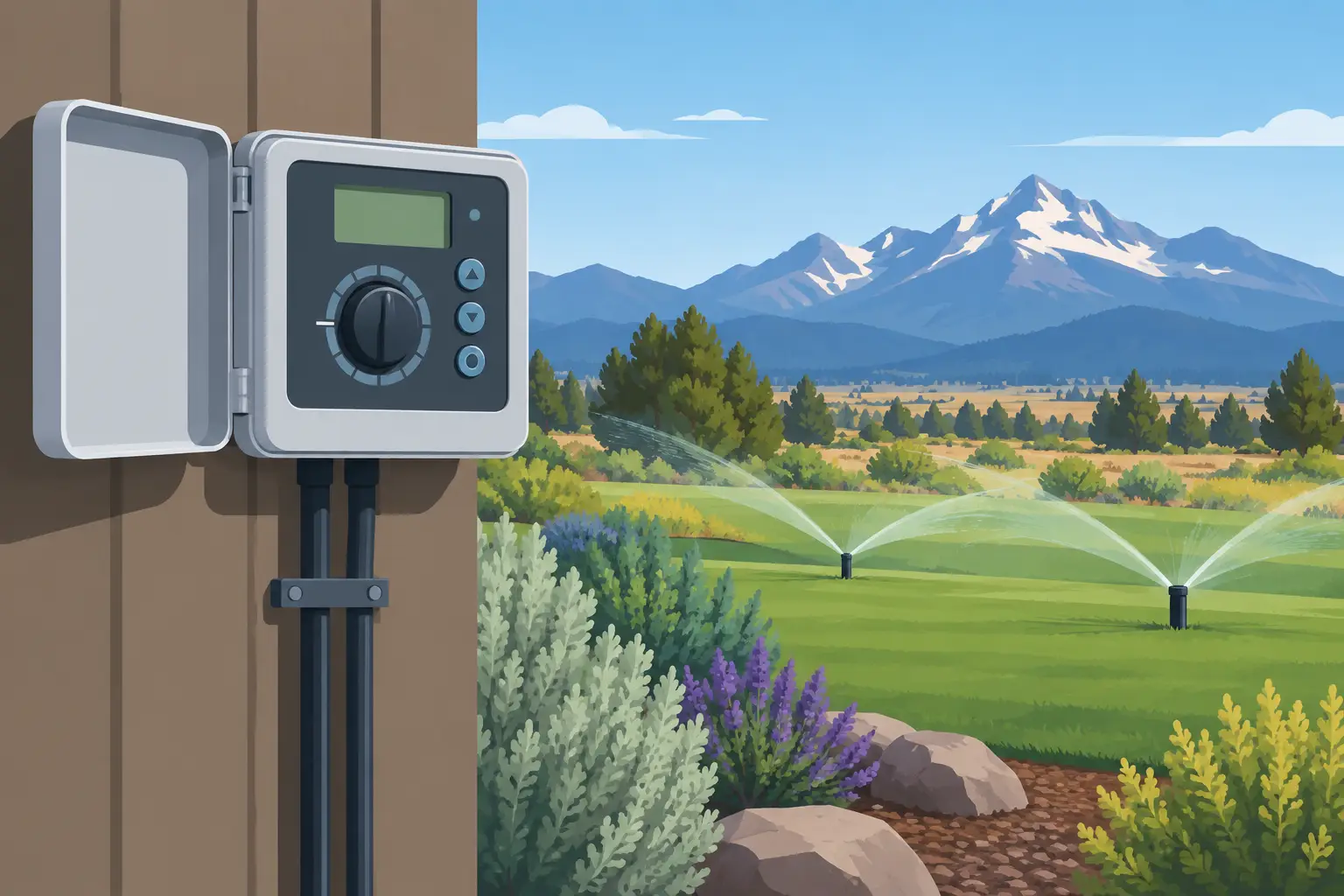
Irrigation Controller Review for Central Oregon
A controller can turn water on at the right hour and still waste a surprising amount of it. In Bend and across Central Oregon, an irrigation controller review needs to look beyond app screens and brand names. Sandy soil drains quickly, afternoon wind can change watering needs, and a lawn’s sunny edge may dry out long before a shaded side yard. The best controller is the one that helps you make useful adjustments without making irrigation harder to manage.
For most High Desert properties, moving beyond a simple mechanical timer is worthwhile. That does not mean every lawn needs the most expensive Wi-Fi model. The right choice depends on the number of zones, the condition of the existing system, how often the property is occupied, and whether the owner will actually use the controller’s smarter features.
What a Good Irrigation Controller Must Do Here
A dependable controller should allow separate schedules for different plant needs. Lawn, established shrubs, new landscaping, drip beds, and containers should not be treated as one landscape. If they are, something will be overwatered or underwatered.
It should also support multiple start times and short runtimes. This matters because Central Oregon’s lighter, sandier soils often absorb water better in cycles than in one long application. A controller with cycle-and-soak capability can run a lawn zone for several minutes, pause to let water move into the root zone, then continue. That reduces runoff on slopes and helps avoid water moving past shallow turf roots too quickly.
Good seasonal adjustment is another practical feature. Spring, July heat, and early fall do not call for the same schedule. A controller that makes it easy to increase or decrease watering by a percentage saves time and discourages the common habit of setting a summer schedule once and forgetting it.
Finally, look for rain-sensor compatibility or built-in weather response. Rain is less frequent here than west of the Cascades, but a sudden storm, cool spell, or smoky period with reduced heat stress can still change demand. A controller should make it easy to pause watering when conditions do not justify it.
Irrigation Controller Review: Three Useful Types
Basic programmable controllers
A conventional programmable controller is often the best value for a small, straightforward yard. It is reliable, usually easy to repair, and gives homeowners direct control over days, runtimes, and start times. For a property with a few lawn zones and perhaps one drip zone, that may be all that is needed.
The trade-off is that it only follows the schedule you give it. If temperatures climb sharply, wind becomes persistent, or a cooler week arrives, someone has to make the adjustment. This is a good choice for hands-on homeowners and landscape crews that visit a site regularly, but it is less forgiving for people who travel or prefer automatic weather adjustments.
Wi-Fi smart controllers
Wi-Fi controllers use local weather data, seasonal trends, or both to adjust schedules automatically. Their strongest benefit is convenience with a purpose: they can reduce unnecessary watering while letting you review and change schedules from a phone.
For Central Oregon lawns, a smart controller can be especially helpful during the shoulder seasons, when fixed summer programming often applies too much water. Many models also provide alerts when a zone runs longer than expected or when the controller loses connection.
There are limitations. Weather data is an estimate, not a soil moisture reading from your exact yard. A controller may rely on a nearby weather station that does not reflect a windy exposed lot, a protected courtyard, or a property with substantial afternoon shade. Wi-Fi also needs a stable signal at the controller location. A smart model is most useful when its recommendations are checked against what the lawn is actually showing you.
Professional-grade controllers
Larger properties, commercial sites, and landscapes with many valve zones often benefit from a more advanced controller. These units may offer more stations, flow monitoring, detailed programming, remote management, and the ability to add sensors. They are built for more complex systems and can help landscapers manage multiple watering priorities without creating a tangled schedule.
The added control comes with added setup. Flow monitoring, for example, can be valuable for identifying a broken line or stuck valve, but it needs compatible equipment and correct configuration. A high-end controller is not automatically a better fit for a six-zone residential lawn. It earns its cost when the system has enough complexity to use its capabilities.
Features Worth Paying For
The feature list can get long quickly, but a few functions make a meaningful difference in daily water management.
Cycle-and-soak scheduling is near the top for many Central Oregon properties. It helps water penetrate without sending it down a driveway or beyond the active root zone. Separate programs for lawn and drip are equally valuable, since drip irrigation typically needs longer, less frequent watering than turf.
A seasonal adjust function is simple but powerful. Rather than rebuilding every program as weather changes, you can reduce all runtimes in spring or early fall with one setting. For homeowners who are learning their system, this feature makes regular adjustment far more likely.
Rain-sensor terminals are useful even if a controller has weather-based scheduling. A physical rain sensor can add a local layer of protection, especially when weather data is imperfect. Flow sensing is worth considering when leaks would be costly or difficult to notice, such as on a larger lot or a commercial landscape.
App control is convenient, but it should not be the deciding factor by itself. A clear controller interface at the wall is still important. If the Wi-Fi drops or a landscape professional needs to make an on-site change, basic functions should remain easy to access.
What a Controller Cannot Fix
No controller can compensate for poor irrigation design. A thirsty lawn zone mixed with drip emitters, mismatched sprinkler heads, compacted soil, or a leaking valve will continue to create problems under any schedule.
Before replacing a controller, check that sprinkler heads provide reasonably even coverage, drip zones are separated from spray zones, and the controller has the correct number of stations for the system. Inspect for clogged nozzles, tilted heads, wet spots, and dry patches. A controller cannot see these issues unless it is paired with the right sensors, and even then it cannot repair them.
The lawn itself matters too. A thin lawn in sandy soil may need better soil structure, appropriate seed, and deeper rooting before it becomes more water-efficient. Watering longer every day is rarely the answer. Healthy turf generally responds better to watering deeply enough to encourage roots, then allowing the surface to dry between cycles as conditions permit.
How to Choose for Your Property
Start with zones, not technology. Count the current zones and allow room for future landscape changes. A homeowner adding a separate drip zone for a garden or new shrubs may appreciate a controller with extra station capacity now rather than replacing it later.
Next, consider how closely you want to manage watering. If you regularly walk your lawn, understand your system, and prefer straightforward controls, a quality conventional controller with a rain sensor may serve you well. If schedules are often forgotten, the property is vacant part of the year, or you want to make changes from work or while traveling, a Wi-Fi model can be a sound investment.
For landscapers, reliability and programming speed often matter as much as remote access. Choose equipment that is easy to service, has clear zone labeling, and gives crews a practical way to test each station. A controller that looks impressive but complicates field work does not improve the account.
Also consider the installation location. Outdoor-rated controllers need a secure mounting area and dependable power. Indoor units should be protected from moisture and placed where programming remains accessible. If Wi-Fi is marginal in a garage or irrigation box, solve that issue before relying on remote control.
Set the Schedule, Then Watch the Lawn
After installation, use the controller as a tool rather than a set-it-and-forget-it device. Run each zone and watch the coverage. Check the soil several inches down after watering, especially in the heat of summer. Look for wilted turf, water collecting at the curb, or consistently greener areas that suggest uneven distribution.
Make changes gradually. If a zone is drying out, first confirm that the heads are operating correctly before adding more runtime. If water is running off, shorten each cycle and add a soak period rather than simply cutting total water. Those small corrections can protect both the lawn and the water budget.
A well-chosen controller gives you better control, but local observation finishes the job. For help matching a controller, sensors, and watering approach to your Central Oregon landscape, Central Oregon Lawn Center can help you work from the conditions in your own yard, not a generic schedule.