
How to Improve Sandy Lawn Drainage in Bend
A Bend lawn can have two seemingly opposite problems at once: water disappears through sandy soil near the surface, yet puddles form in a few stubborn spots after irrigation or a spring storm. Knowing how to improve sandy lawn drainage starts with identifying which problem you actually have. In Central Oregon, the goal is rarely to make soil drain faster everywhere. It is to help water move evenly through the root zone, avoid runoff and pooling, and hold enough moisture for healthy turf without overwatering.
Sandy soils are common across the High Desert, but no two yards are exactly alike. Construction traffic, buried fill, thin topsoil, compacted subsoil, and an uneven grade can all interrupt normal water movement. A practical fix begins with observation, then uses the least disruptive solution that fits your lawn.
First, Find Out Why Water Is Pooling
Before adding sand, gravel, or a drain, watch what happens during a normal irrigation cycle. Mark areas that puddle, turn soft underfoot, or remain darker and wetter than surrounding turf for more than a day. Also note whether the issue appears only after a long sprinkler run or after every watering.
If water stands in one low area, the likely cause is grade. Water naturally follows the lowest path, and even a shallow depression can collect enough irrigation water to weaken grass roots. If puddling occurs in broad, irregular patches, compacted soil or a dense layer beneath the lawn may be restricting downward movement.
A simple infiltration test can provide useful information. Push a straight-sided can several inches into the soil, fill it with water, and see how long it takes to drain. Compare a problem area with a healthy area. If the wet spot drains far more slowly, soil compaction or a restrictive layer is likely involved. If both drain quickly but one area still puddles, look more closely at sprinkler output and grade.
It also helps to dig a small test hole about 8 to 12 inches deep. You may find loose, sandy soil on top of a hard construction layer, dense clay, or compacted native material. This is common in newer landscapes where topsoil was spread thinly over subgrade. That boundary can act like a shelf, allowing water to perch near the surface.
How to Improve Sandy Lawn Drainage Without Creating Drought Stress
The common advice to add sand for drainage does not fit most Central Oregon lawns. If your lawn is already sandy, more sand can reduce its ability to hold water and nutrients. Turf may drain quickly after irrigation but develop shallow roots, dry patches, and higher water demand. The better approach is to improve soil structure while addressing the source of pooling.
Core aerate compacted areas
Core aeration is often the most effective first step for a lawn that feels hard, sheds water, or puddles after irrigation. A core aerator removes small plugs of soil rather than simply poking holes. Those openings allow water, air, and roots to move through the turf profile more easily.
For established Central Oregon lawns, aerating during active growth gives grass the best chance to recover. Spring and early fall are usually good windows, although timing depends on the grass type, weather, and irrigation availability. Leave the plugs on the lawn so they can break down and return soil and organic matter to the surface.
One pass may be enough for mild compaction. Areas affected by construction traffic, pets, frequent foot traffic, or equipment may need more thorough aeration. If you rent equipment, choose a true core aerator rather than a spike aerator. Spikes can temporarily open the surface but may compact soil around each hole.
Topdress with finished compost, not sand
After aeration, apply a light topdressing of high-quality finished compost. A layer around one-quarter inch is enough for most lawns. The grass blades should remain visible after application. Compost works its way into aeration holes and gradually improves the soil’s ability to absorb water while also holding moisture and nutrients where roots need them.
This is the balance sandy lawns need. Organic matter helps water enter the soil more consistently, reduces the tendency for irrigation to race through the profile, and supports deeper rooting. It can also improve the transition between sandy topsoil and denser material below.
Avoid heavy applications that smother turf or create a new, sharply defined layer at the surface. Repeated light applications are more useful than one thick application. For lawns with very little organic matter, an annual topdressing program can make a noticeable difference over several seasons.
Correct low spots with the right soil blend
When standing water is limited to a clear low spot, improve the grade rather than trying to force water through the soil. Minor depressions can often be corrected gradually by topdressing with a lawn-safe soil blend that contains screened topsoil and compost. Apply thin layers, allow turf to grow through, and repeat as needed.
For a deeper low area, the lawn may need to be lifted, regraded, and re-established. This takes more work, but it is more dependable than repeatedly adding material to a spot that continues to settle. Keep the finished grade moving gently away from foundations, walkways, and other structures. In a water-conscious landscape, directing excess water toward a planted area can be more useful than sending it toward the street.
Do not use straight sand to fill a depression in an already sandy lawn. It can settle differently than surrounding soil and may worsen dry conditions once the grade is corrected.
Check Irrigation Before Installing Drainage
Many apparent drainage problems are actually irrigation problems. Sandy soil accepts water quickly at first, but a compacted layer or low area can become saturated when sprinklers run too long. High-output nozzles, mismatched sprinkler heads, or a tilted head can put far more water in one area than the lawn can use.
Run each irrigation zone long enough to observe coverage. Look for overlapping streams, water hitting hardscape, misting in the wind, and areas where heads apply water faster than the soil can absorb it. Low humidity and summer heat make it tempting to run long cycles, but longer is not always better.
Cycle-and-soak watering is especially helpful where infiltration is uneven. Instead of running one zone for 20 minutes at once, run it for 10 minutes, let the water soak in, then run another 10 minutes later. The pause gives water time to move into the root zone instead of flowing into a low spot or off the lawn.
Adjust schedules seasonally and after rainfall. A lawn with improved soil structure and deeper roots often needs less frequent irrigation, even during dry Central Oregon weather. Watch the lawn rather than relying only on a fixed timer. Grass that springs back after being stepped on generally has adequate moisture; footprints that remain visible can signal drought stress.
When a French Drain or Catch Basin Makes Sense
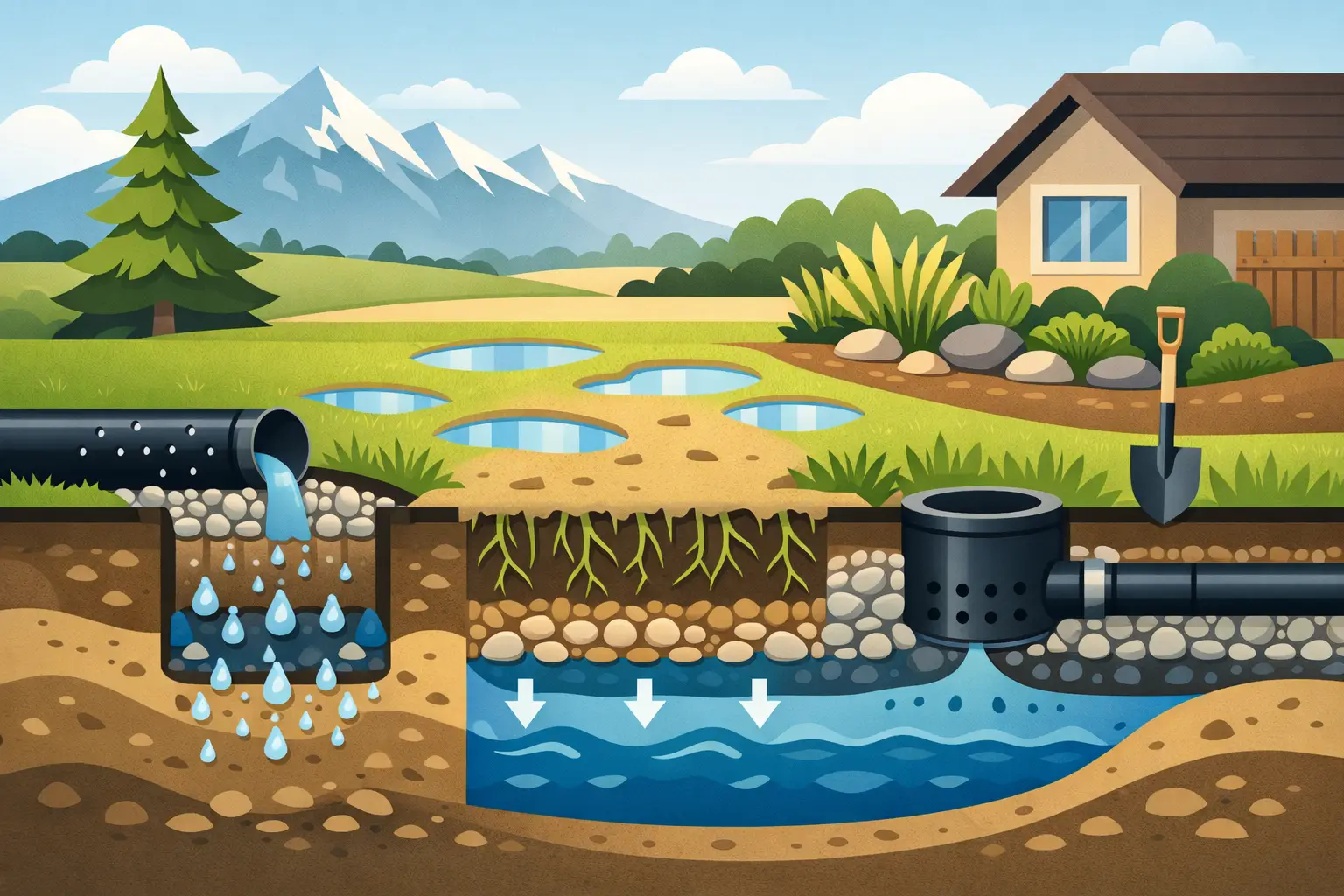
Subsurface drainage is not the first answer for every wet patch, but it can be appropriate when grade and soil work cannot solve the problem. A French drain, catch basin, or buried drain line may be needed where runoff repeatedly enters the lawn, water collects against a hardscape edge, or a naturally low location has no safe surface outlet.
These systems require careful planning. The drain needs a proper slope and a legal, practical place for water to discharge. Installing a perforated pipe without an outlet simply creates a gravel-filled trench that can fill with water and sediment. In sandy soils, use suitable filter fabric and washed drain rock where appropriate to keep fine material from clogging the system.
Consider the larger landscape before trenching. If the wet area is caused by a broken irrigation line, a downspout, or runoff from a neighboring grade, fixing that source may cost less and preserve more of the lawn. For larger drainage corrections, trenching equipment can reduce labor, but the layout should be planned before digging.
Support Turf That Can Handle High Desert Conditions
Drainage improvements work best when paired with turf suited to the site. Grass with a deeper, healthier root system handles brief wet periods and dry summer stretches better than shallow-rooted, stressed turf. Appropriate seed blends, sensible fertilization, and mowing at a healthy height all help roots explore more soil.
Avoid trying to solve drainage issues with excessive fertilizer. Fast top growth can increase water demand without correcting the soil beneath it. Instead, build the root zone with compost, aeration, and measured nutrient applications that fit the season and your lawn’s condition.
If a section of lawn repeatedly fails because of shade, traffic, poor grading, or a drainage path, consider whether turf is the best use of that space. A carefully chosen planting bed, dry creek feature, or water-wise landscape area may handle the conditions better while reducing irrigation demand.
A healthier lawn in Bend is not about making every square foot drain the same way. It is about understanding where water stops, where it disappears too quickly, and how the soil behaves beneath the grass. If you are unsure whether your lawn needs aeration, topdressing, irrigation adjustment, or a more involved drainage correction, bring in a few observations and photos. Central Oregon Lawn Center can help you choose a practical, environmentally responsible next step for your specific yard.