
Organic Lawn Fertilizer Review for Bend Lawns
A fertilizer can look excellent on a bag and still disappoint in a Central Oregon yard. Our short growing season, sandy native soils, bright sun, low humidity, and irrigation limits change the equation. This organic lawn fertilizer review looks at what organic products can realistically do for Bend-area turf, where they fall short, and how to choose one that supports a greener lawn without pushing unnecessary growth or water use.
What an Organic Lawn Fertilizer Does Differently
Organic lawn fertilizers feed the soil as well as the grass. Their nutrients commonly come from natural materials such as composted manure, poultry litter, alfalfa meal, kelp, feather meal, or plant-based meals. Rather than delivering all nutrients immediately, many organic materials rely on soil microbes to convert them into forms turf can use.
That slower process is their biggest advantage and their biggest trade-off. A quick-release synthetic fertilizer can produce a rapid color response, especially when a lawn is already irrigated and actively growing. Organic fertilizer usually works more gradually. It supports steadier growth, encourages microbial activity, and can help build a healthier root-zone over repeated applications.
For High Desert lawns, that long-term approach matters. Sandy soil does not hold moisture or nutrients well. When a lawn receives a large, fast dose of soluble nitrogen, the grass may green up quickly but can also require more mowing and more water. A measured organic program is often better aligned with the goal many local homeowners share: durable turf that looks good through heat, wind, and dry stretches.
Organic Lawn Fertilizer Review: What We Look For
The word “organic” alone is not enough to make a fertilizer a good choice. Product quality depends on the nutrient analysis, the ingredients, the application rate, and whether it fits the condition of the lawn in front of you.
A balanced analysis beats a high nitrogen number
For an established lawn in Central Oregon, an extremely high-nitrogen fertilizer is rarely the best starting point. Nitrogen drives leaf growth and color, but too much can create a thirsty, fast-growing lawn that becomes harder to manage. A balanced organic blend with moderate nitrogen is generally more practical for routine feeding.
Look beyond the first number on the bag. Phosphorus supports rooting, but established turf often does not need large amounts unless a soil test shows a deficiency or you are establishing seed. Potassium can be especially useful for stress tolerance, although the right amount still depends on your soil. A soil test takes the guesswork out of this decision and prevents paying for nutrients your lawn does not need.
Slow-release nutrition is a real benefit
A good organic fertilizer should provide a controlled, predictable feeding window instead of a one-week burst of dark green growth. That makes it useful for homeowners who want a more even lawn and for landscape professionals maintaining multiple properties on a schedule.
Slow release does not mean no response. If the lawn is watered properly and soil temperatures are warm enough, you should see improved color and density. Expect the change to develop over a few weeks, not overnight. That patience is part of the value: less boom-and-bust growth, fewer dramatic mowing surges, and a lawn that is less dependent on constant intervention.
Pellet size and spreader compatibility matter
This detail gets overlooked until a striped, uneven lawn appears two weeks after application. Dry organic fertilizers can be dusty, light, or irregularly shaped. Fine materials may bridge in a spreader, while larger pellets can scatter unevenly if the spreader setting is too open.
Choose a product that can be applied consistently with your equipment, and always calibrate on a small area first. Walk at a steady pace and make overlapping passes rather than trying to cover the lawn in one wide pass. If a product has a strong natural odor, apply it before a planned irrigation cycle and avoid spreading immediately before an outdoor gathering.
Where Organic Fertilizer Performs Best
Organic lawn fertilizer is particularly effective when the goal is improvement over time. It is a strong fit for an established lawn with thin growth, dull color, compacted soil that has been aerated, or soil that needs more biological activity and organic matter.
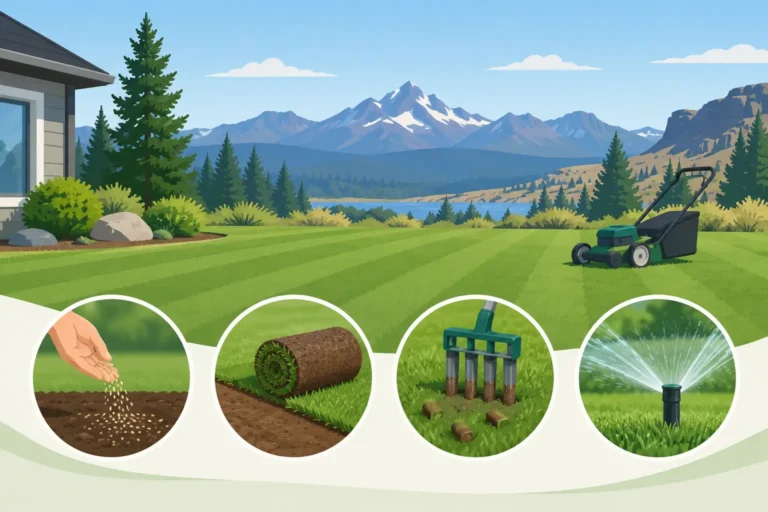
It also works well alongside the practices that make the biggest difference in Bend lawns: correct mowing height, efficient irrigation, core aeration, and quality grass seed suited to the High Desert. Fertilizer cannot compensate for a sprinkler system that misses half the lawn or a turf variety that struggles in full afternoon sun. It can, however, help a well-managed lawn develop better density and resilience.
For a newly seeded lawn, organic fertilizer can be useful, but timing and nutrient balance matter more than the label category. New seed needs consistent moisture and a favorable root-zone. A starter product may be appropriate when soil testing or site conditions call for it. Avoid assuming that more fertilizer will make seed establish faster. Excess nutrients can stress young turf and waste water.
The Trade-Offs to Know Before You Buy
Organic products are not automatically the best answer for every lawn problem. Their slower release depends on active soil biology, which means response can be limited in cool spring weather or in severely depleted soil. If your lawn needs immediate correction for a documented nutrient deficiency, a targeted product may be more appropriate than a broad organic feeding.
They can also cost more per application than conventional fertilizers. The comparison should not stop at bag price, though. Consider coverage, nutrient content, application frequency, mowing demand, and whether the product supports your broader water-wise lawn plan. A cheaper product that triggers excess growth may not be the lower-cost choice over a season.
Another consideration is nutrient sourcing. Some organic fertilizers use animal-based ingredients, which can attract dogs or wildlife if spilled or left on the surface. Follow the label, sweep fertilizer off hardscape, and water it into the turf when directed. Natural ingredients still need responsible handling.
A Practical Feeding Schedule for Central Oregon
Most established cool-season lawns in the Bend area benefit from feeding when they are actively growing, not when they are struggling through summer heat. A light spring application after the lawn has begun growing is often a sensible first step. Apply only after irrigation is operational and the ground has warmed enough for grass and soil organisms to respond.
A second application in early fall is often the most valuable feeding of the year. Cooler nights and milder days encourage root development, while reduced heat stress allows turf to use nutrients efficiently. Fall feeding can help a lawn recover from summer wear and enter winter with better density.
A midseason application may be useful for lawns with heavy use, sandy soil, or a documented nutrient need, but it should be modest. During hot, dry periods, focus first on irrigation coverage, mowing height, and traffic management. Fertilizing a drought-stressed lawn is not a substitute for water, and applying too much nitrogen can make stress worse.
Use the bag’s labeled rate, then adjust only with a clear reason. More fertilizer is not a sign of better lawn care. In sandy soils, smaller, well-timed applications are usually safer and more effective than one heavy feeding.
Get Better Results From Every Application
Mow before fertilizing if the lawn is overgrown, but avoid scalping it. Apply fertilizer to dry grass, then water according to the label directions so nutrients move into the root zone. Keep product off sidewalks, driveways, and drainage areas, where it cannot help your lawn and may wash away.
If your lawn feels hard underfoot or water runs off instead of soaking in, consider core aeration before a major feeding. Aeration opens channels for water, oxygen, and nutrients while creating a better environment for roots. A light topdressing with quality compost can further improve sandy soil, but it should be applied thinly enough that grass blades remain visible.
For patchy or aging turf, pair fertilizer with overseeding using a grass blend selected for Central Oregon conditions. Seed, soil preparation, and watering habits will determine the renovation outcome far more than fertilizer alone. Central Oregon Lawn Center can help match the right fertilizer, seed, amendment, and rental equipment to the actual condition of your property.
A healthier lawn here is not the one that grows fastest after a feeding. It is the lawn that develops deeper roots, uses water thoughtfully, and still holds its color and coverage when Central Oregon summer asks more of it.